
One week to M2030 Launch Day: between the chapters.
On Sundays in the run-up to Istanbul, I’ve been walking through what we learned in Marketing2030, phase by phase. The last chapter, on where Marketing leaders can best increase their impact and what kind of CMO it takes, comes next week. This post is different. Exactly a week before we launch, I’d like to take a step back and talk about why we do what we do, how we do it, and with whom. Certainly not a celebration of us, but of the people and organizations who made M2030 possible.
Eight years ago, we started the Institute for Real Growth with a simple observation. Marketing leaders all over the world were running into the same challenges, and almost nobody was pulling their learning together. A CMO is often the most senior person in their discipline in the company. No one down the hall has done the job before. It can be lonely at the top.
There’s no shortage of CMO gatherings, and many more are popping up every year. If you’ve been to a few of them, as I have, you know the question quickly becomes which one deserves your time. And underneath that sits a harder question: where is the safe space? Where can I sit with peers and talk honestly about what’s going well, and about what isn’t, without a headhunter in the room noting that I’m struggling, a competitor taking quiet notes on what not to do, or an account manager who plays my own words back to me in the next sales call as a deep understanding of my business? And how can I trust what’s being shared with me if the person sharing it needs me to buy a product, a service, or a technology at the end of it?
So, we built IRG around one rule: nobody in the room is selling anything. We operate as a not-for-profit and independent CMO leadership institute. The IRG100 program is by invitation only and complimentary for every participant, and we take great pains to ensure that not a single person in the room has anything to sell. In seven years of running IRG100, we have never had a complaint from a participant who felt they couldn’t open up because of someone else at the table.
We also carefully vet every participant before we start. Everyone in the room has about 20 years of experience. And we build each cohort for diversity of lived experience: region, industry, category, B2B and B2C, the importance of brands to their business, and the maturity and centrality of Marketing in their business.
Then there is what we ask of people on day one, which may be the most important thing IRG does. We ask participants not to share where they work, what their title is, how many people report to them, or how big their budget is. There is zero ‘my business card is bigger than yours.’ A six-month journey starts with the human in the room and a conversation about what constitutes growth in the broadest sense: personal, business, and societal.
Over the years, we noticed that some sessions consistently scored higher than any others, and for a while, we weren’t sure why. Now, IRG is very far from a sit-around-the-campfire program. But the short, Ashley Wray-led deep meditation at the start of every day, from the very first hour of the first workshop, lets people let go of their day-to-day and be fully present to learn. Dabney Hailey’s Visual Thinking Strategies training has been part of the program since the very beginning and remains one of the highest-rated components every single time: leaders learn to listen differently, and to see that how they lead and how they play their role matter as much as the strategy itself.
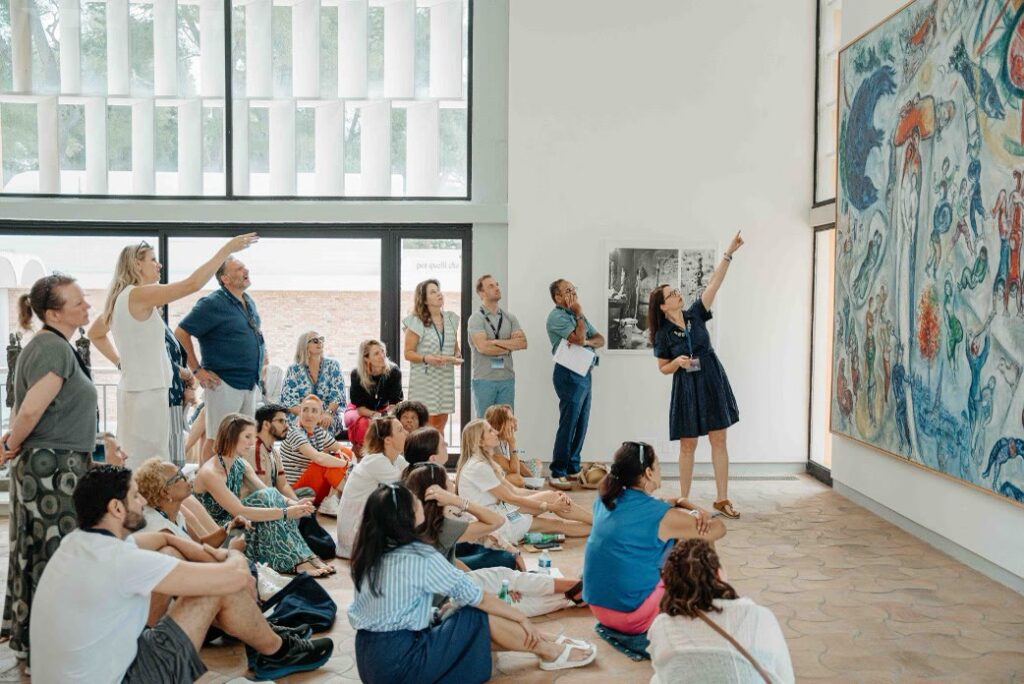
More recently, we asked Vincent de Klerk to bring in constellations, where a CMO positions their internal stakeholders, the CEO, the CFO, the CHRO, relative to themselves and senses how those stakeholders relate to them and to what they’re proposing. It has produced some of the biggest unlocks we’ve seen in what it takes to win support for a Humanized Growth strategy.
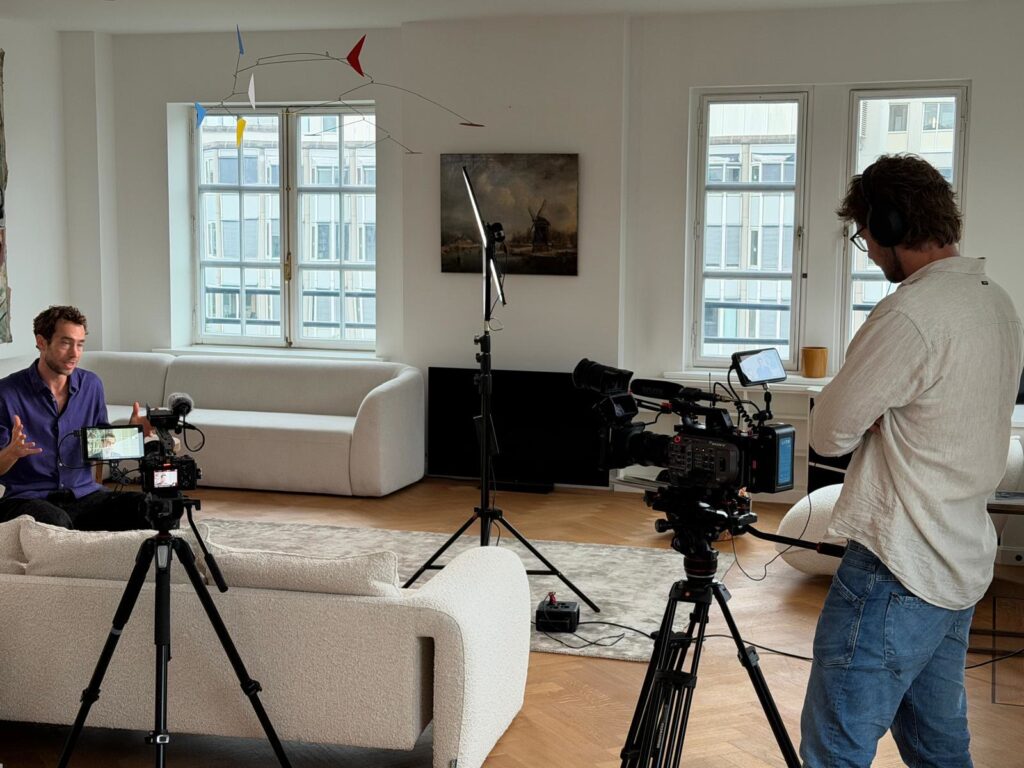
That’s the heart of it. Around that heart, IRG has grown into a pyramid of engagement. At the top, once a year, 25 of the most senior Marketing leaders in the world step back for a five-day retreat to reconnect with their personal and business purpose. Then IRG100: 100 CMOs, six months, each developing their own Humanized Growth strategy. Below that, the multi-hour CMO Summits that we run with our partners in major cities around the world, where peers share what’s working, discuss it with each other, and leave with an action plan; by the end of 2026, about 2,500 CMOs will have taken part. Then the IRG presentations at Marketing conferences around the world, where, again, by the end of 2026, over 15,000 marketers will have heard the Marketing2030 learning presented in person. And finally, this newsletter, which goes to about 12,000 people every month, and our website, where all our reports live. As I write this, I can hear my colleague Aljan de Boer in another room recording videos for our website and social media to help bring the M2030 content alive.
You’ll have noticed that the last two are one-way. There is no one at the next table to turn to. And that has bothered us for a long time, because such an important point of the IRG is the connection to peers, experts, and thought leadership.
Which is why I’m so proud of what we’re launching in Istanbul next week, alongside the Marketing2030 findings: the IRG Inspirator.
You can start by taking the Marketing2030 benchmark survey, and in return, you are connected to insights, best practices, and tales from the trenches that are tailored to your specific situation, questions, and challenges. Everything is built on the study findings and what the IRG community has learned. It listens, helps you map where you are, tailors its answers to help you engage your organization and develop a Humanized Growth strategy, and drives change. It runs human in the lead and is enabled by Google’s Gemini, with IRG applying its own Marketing2030 recommendation for hybrid capability to itself. If an answer isn’t practical enough, there’s a built-in route to take your question to the broader IRG community of over 1,000 CMOs and get their perspective. It’s available at no cost.
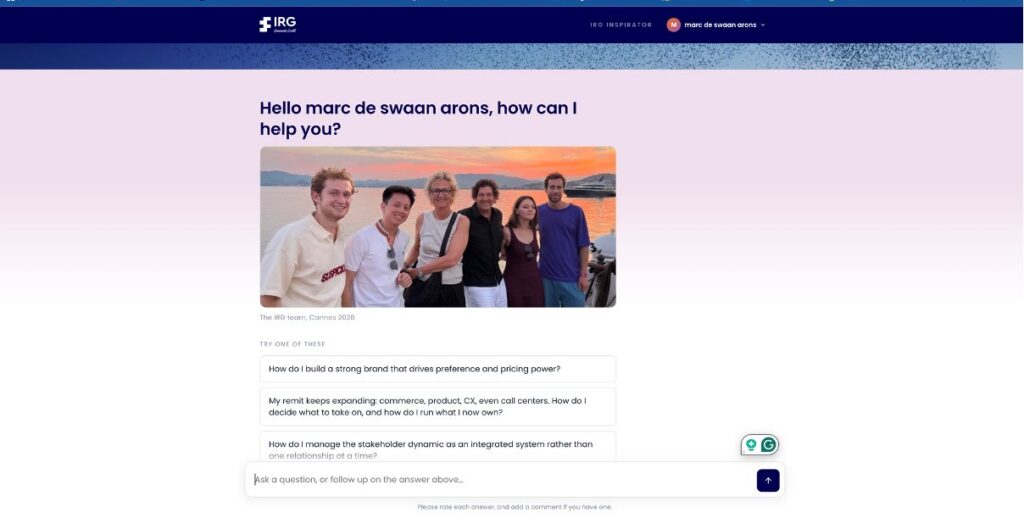
Our ambition is that the IRG Inspirator will give hundreds of thousands of Marketing leaders worldwide access to the same learning available to a CMO participating in the IRG100 program. Of course, it won’t be the same as turning to three other CMOs sitting at your table to challenge or build on your ideas, but it will give many more leaders access to all our learning, dramatically better insight and help more businesses drive more Humanized Growth.
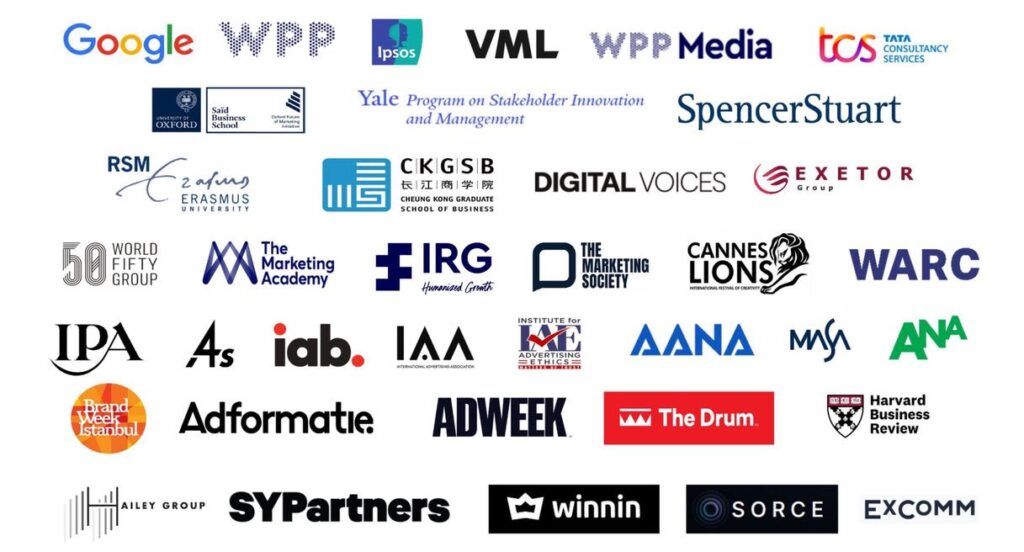
Eight years in, with Marketing2030 and the Inspirator, it feels like the biggest opportunity to deliver fully on the IRG purpose. And this is truly a collective accomplishment. The outcome of a movement. I am so proud of the contributions by more than 1,000 CMOs who have either come through the 12-week ANA Marketing Leadership Program, or our flagship 22-week IRG100 program. And we cherish our partnership with more than 25 Marketing leadership organizations, including the AANA in Australia, the IAB, and MASA in South Africa. We are so grateful for the support of our partners Google, TCS, Ipsos, and WPP, who have carried Marketing2030 from Day One without ever trying to influence the programs with short-term commercial interests. Perhaps I’m most proud of the IRG team, which is as global as the community it serves: our finance manager in Nairobi, our operations manager in Indonesia, my assistant in the Philippines, our academic researcher in the UK, and of course, our teams of highly experienced professionals in Amsterdam and New York.
So, if you’re a CMO reading this and thinking that the room I’ve described is one you’d like to be in, register to join one of the M2030 events, or apply to join the 2027 IRG100 program. Program registration closes on October 4. More information below.
Next week, the last chapter before Istanbul: I will focus on the areas where Marketing leaders can best step up, and what kind of CMO it will take to win. Please reach out if you want to add your perspective or an example.
My Best,
Marc de Swaan Arons
Founder, IRG