Two weeks to M2030 Launch Day: Chapter 3.
Marketing2030 was designed as a four-phase journey, with each phase addressing a question left by the previous one. First, we looked outside in, at the world businesses now have to grow in. In Phase Two, we looked at how companies are responding to that world and the role of Marketing in that response. In Phase Three, we looked at how Marketing can make the biggest enterprise growth contribution, and finally, we looked at what it takes for Marketing leaders to step up. You can access the reports covering the results of the previous phases here.
Two weeks ago, I explained the case here for why we started M2030: a company exists to serve people, and long-term shareholder value is the outcome of doing that well. Last week, I described where the journey began, looking outside in, and the six M2030 Growth Paradoxes.
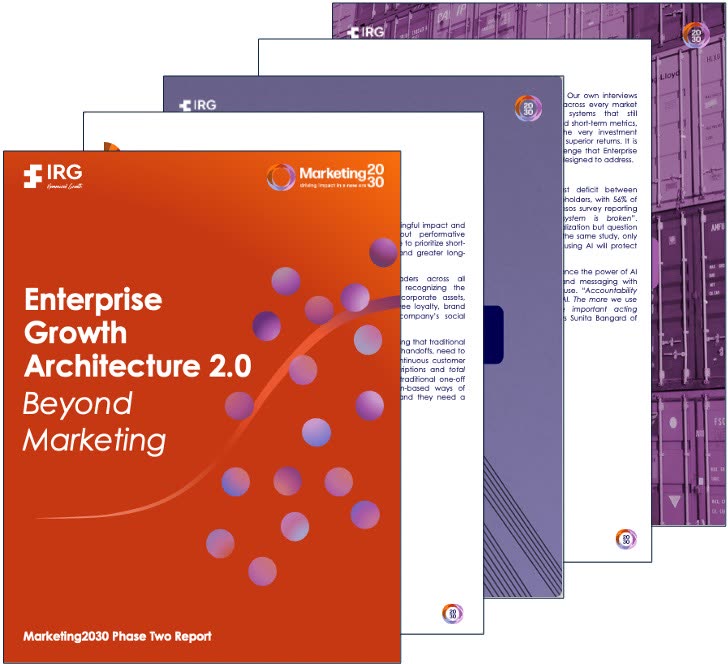
This week, I want to focus on the findings of phase two: how winning organizations are evolving to succeed in this new world, and what role Marketing needs to play.
To find out, we conducted more than 500 interviews with experts, academics, Board members, CEOs, CMOs, and Marketing’s C-suite peers across 15 markets on 5 continents. We analyzed more than 1,550 expert and Board governance reports, 1,000 investor calls, and over 6,000 leadership podcasts in five languages.
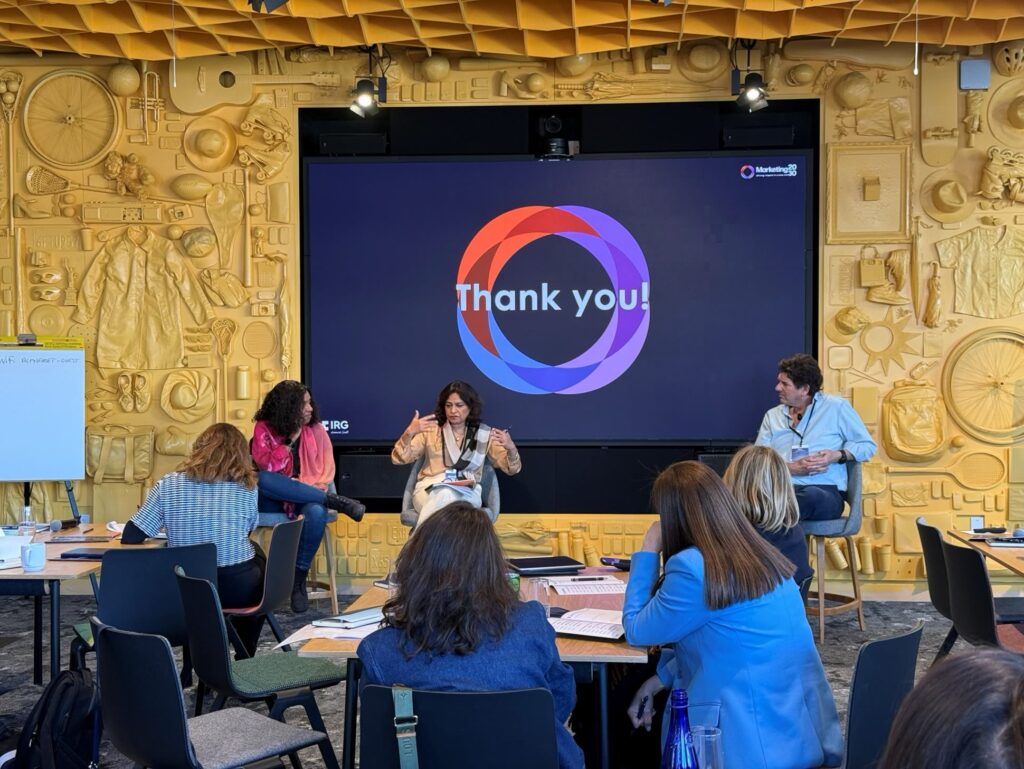
Our findings were then discussed, and in places taken apart, by the fifty members of the Marketing2030 Leadership Lab, among the most senior Marketing leaders and industry influencers globally. Many of these CMOs are IRG alumni, marketers who went through our program and came back to help the ones who follow.
It’s becoming clear that the dramatic developments in technology, specifically AI, together with recent geopolitical uncertainty, have caused a structural shift in how businesses operate. Every function now operates in a world of instability. Markets are more polarized, consumers more volatile, talent more anxious, and capital more impatient. AI is amplifying both productivity and instability. Trust, long treated as a soft, nice-to-have outcome, is becoming a business requirement and an essential asset.
The growth models built on scale, efficiency, and optimization still matter, but they are no longer sufficient: too siloed for relationship-led growth, too fragmented for coherent trust-building, and too focused on downstream execution when enterprises need help making upstream choices. Leaders across every function are recognizing the importance of the more intangible corporate assets: reputation, employee loyalty, brand equity, culture, and the company’s social license to operate.
We learned that the companies responding best had, in effect, started to reorganize themselves, building what we are calling an Enterprise Growth Architecture 2.0. At its core, running on a dual operating logic: an AI-powered efficiency engine that drives speed, scale, and economic advantage, and a human-powered business engine that delivers profitable solutions to customer needs, builds trust, shapes culture, and creates lasting relevance.
Neither of these two is sufficient alone. Businesses that optimize only for efficiency risk becoming commoditized. Those who invest only in meaning risk losing investor support. The companies that outperform are those that learn to run both engines simultaneously, with the organizational design, shared metrics, and leadership alignment to keep them in sync.
Three themes that shape this new growth architecture matter most to Marketing. The first is geopolitical and economic fragmentation, where Marketers are being asked to help the enterprise make sense of external change. Antonio Lucio of HP was direct about it: the world is changing so fast that it is Marketing’s duty to bring context, clarity and understanding within the company.

The second important theme is what Deloitte calls ‘stagility’, the right mix of stability and agility so Marketing colleagues feel safe enough to innovate, share results, and even fail. Asmita Dubey explained how L’Oréal rebuilt Marketing around defined skills, organized into communities of media, measurement, CRM, and influencer, so that people have a community at work, a home base while the work keeps moving.
The third theme has to do with the widening trust deficit: 56% of respondents in a recent Ipsos survey among the general population believe the ‘system’ is broken, and only 48% trust companies using AI to protect their personal data. In response, business leaders are placing significantly greater importance on building and protecting trust as a corporate asset.
Underlying all three themes is the constraint our work identifies more consistently than any other: the structural and increasing lock-in of short-term thinking. This is not a failure of strategic intent; every leader we spoke with understands the value of long-term brand investment. It is a failure of system design. Incentives, measurement frameworks, investor expectations, and leadership tenure cycles. Collectively, these pull organizations toward short-term decisions regardless of what the strategy says.
What also became clear in Phase Two is that the next era of competitive advantage will belong to the companies that can best apply what my friend and co-founder Frank den Driest calls the ‘Human Quotient’: The growing strategic value of the capabilities AI cannot yet replicate, such as empathy, judgment, creativity, curiosity, storytelling, and contextual understanding.
Dean Aragon, the former CMO of Shell, emphasized that in a world increasingly defined by agentic AI, human agency is the only remaining differentiator, and that if unchecked, AI will accelerate commoditization. Patricia Corsi, the CMO of Kimberly-Clark, told the Leadership Lab where the premium now sits in content that is raw, unmistakably human, and intentionally imperfect, because that is how you stand out in a sea of average AI output.

Recognition of the importance, and demand for, the human perspective is now coming from every corner of the C-suite: CEOs want customer-centricity rooted in data rather than C-suite bias. CFOs now see stakeholder intimacy as both a value-creation opportunity and a way to mitigate financial risk. HR leaders want customer-experience principles applied to the candidate and employee journey.
And this is where a new opportunity for Marketing appears: Winning businesses are applying what we call Humanized Growth principles to every part of the business: uncovering unmet needs for each stakeholder, understanding context, shaping perception, and driving meaning. And it’s the marketers who can help bring the ‘human’ perspective to any discussion.

One small example: Show a room of executives this picture of a man – the one with the silver suitcase – in an airport security line and ask them how they think he feels. Most executives will look at the data: twenty people ahead of the person, with no obvious forward progress, and conclude that the man must be feeling very frustrated. Only a marketer is likely to first ask how many people are in line behind the man, and explain that the emotion of waiting in line is shaped predominantly by a person’s relative position in the line. Context determines feeling. A human insight that a good marketer will always bring into the discussion.
M2030 finds over and over that companies aren’t tapping into their marketers’ ‘superpower’ of providing the human perspective enough: One acid test question: When we ask the CMOs in our programs whether their company’s HR-led communication is as strong as their own brand campaigns, almost all say ‘no’, even though the same leaders completely agree that recruitment is crucial to their business’ success.
Most companies deploy Marketing skills to sell products, but not to identify growth markets, recruit talent, shape investor narratives, or build community trust. That gap gave us the question that carried us into the next phase of the work: what enterprise value creation and growth role can, and should Marketing play beyond Marketing?
This is not a rallying cry for a Marketing land grab. In fact, we believe this calls for serious introspection among CMOs. Why aren’t our colleagues asking more for our support? Perhaps it’s because there is no generally accepted definition of the role of Marketing. I struggle to name another function you could say that about. Most Board members admit to not fully understanding how Marketing contributes to business growth, and many of our C-suite peers feel that we’re not commercial enough. That means we’re not really seen as business partners.
Some feel that Marketing today is having an identity crisis, but we believe this actually indicates that there is an existential business challenge that needs to be addressed: Marketing is often under-resourced because it cannot demonstrate value in the current financial metrics, unable to do so because the company is not measuring and celebrating all the value that Marketing is creating for the business. At the root sits a measurement problem that, as Jonathan Knowles of Type 2 Consulting reminds us, excludes many, if not all, intangible assets. Marketing’s contribution cannot be properly assessed as long as businesses default to financial metrics as the sole measure of success.
What we see in winning organizations is that it takes partnering at the C-suite level to address this: It requires the CEO to co-design the CMO role, the CFO to co-own the KPI framework, the Board to understand how Marketing contributes to enterprise value, and the CMO to demonstrate, in the language of the business, why Marketing’s capabilities are essential.
Marcel Bucsescu of the National Association of Corporate Directors explained to us that high-performing Boards and C-suite teams do not leave Marketing’s role to interpretation. Some companies and CMOs are leading the way. Tariq Hassan, now the CMO of Wendy’s, helped his colleagues at his former employer, McDonald’s, rebuild franchisee recruitment around target personas and an all-digital acquisition approach. The question is not whether Marketing should own more, but whether the company is applying a more Humanized Growth approach where it matters most. The companies that get this right do not simply have better Marketing. They have better businesses.
For marketers, the findings of Phase Two are reassuring, unsettling and exciting. Reassuring, because Marketing’s core strengths have never been more relevant. Unsettling, because there is no agreement on what the role is or should be. Exciting, because Boards and C-suite peers are actively seeking the expertise Marketing brings.
All of it comes back to the idea I opened this series with, which, by this point in the journey, had become the lens through which we read everything: that sustained business success for shareholders and greater human value creation for all stakeholders are not in tension but aligned. That is Humanized Growth.
Next week, I will share what we have learned about the areas where Marketing leaders can best step up first and what kind of CMO it will take to win. Please reach out if you want to add your perspective or an example.
My Best,
Marc de Swaan Arons