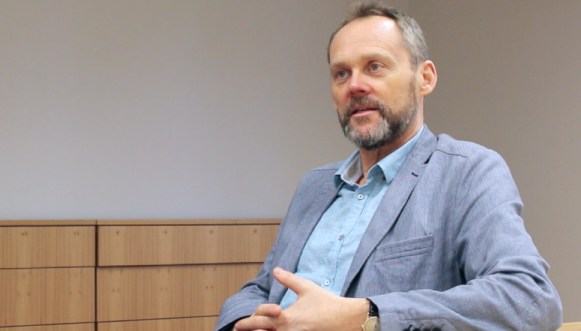
F I'm pleased to have with me today, Lucas
Perraudin. Lucas is currently at Facebook,
heading up AR and VR for the EMEA region. Today,
we're going to talk about commerce. What's going on?
Where are we coming from? And where are we going?
STATE OF COMMERCE
L Firstly, this is a very complex topic that has a
very high rate of change. If you have a hard
time keeping up, you’re not the only one. I work at
Facebook, and even I sometimes struggle.
Another thing I will say up front is that while there is an
evolution of commerce, one behavior doesn't
necessarily replace another. They will all coexist over
time. And that also makes things more complex.
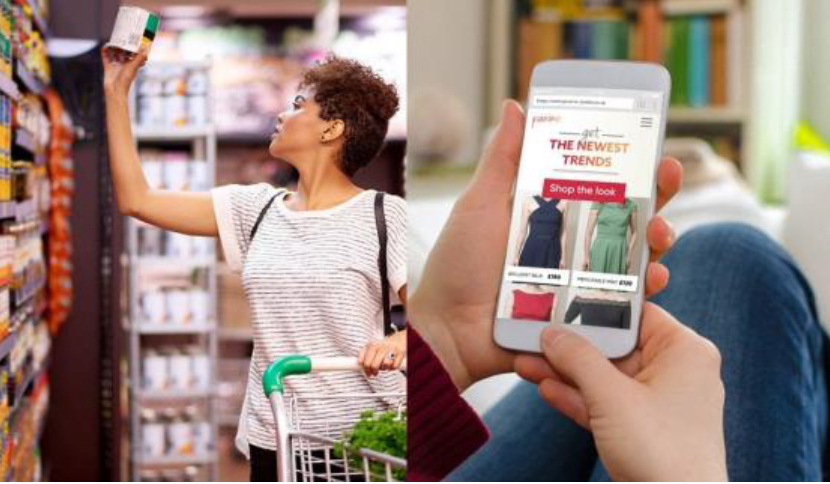
Let's talk about how people still shop – it’s bricks and
mortar. People still mostly buy in physical stores. Outside
of COVID, the consensus statistic was that around 70%
of everything bought was still bought in physical retail.
But it doesn't mean that physical retail has been a
stable purchase point. The role of physical retail in the
customer journey is evolving as we speak.
The conversion rate at physical retail is twice what it
was 10 years ago. When people show up in a store,
they have a propensity to buy that is twice as high as it
was 10 years ago. Why? Because they browse online
before. They do a lot of research. And by the time they
show up in a store, they're actually there to buy. And
this has a lot of implications - having the right inventory
at the right price and being consistent in the physical
store with the experience that was served online is
incredibly important.
In the next two, three years, you will hardly
show up at a physical store without knowing that what
you want to buy is actually there. This means there is
very little chance for substitution. Once you get to the
store, you are very likely to buy what you came there
for. That exact product.
The implication for brands is a full funnel marketing
strategy. You need to be reaching potential buyers
with appropriate messages at every stage of the
customer journey.
The other implication is the consistency. You need to
make sure that what you advertise is in stock. Often
channel marketing, sales and supply chain aren't in
sync. But now it's really important that what you
advertise is actually purchasable within the purchase
location that the go-to-market decisions were made in.
It's great for marketers, it's great for sales, because
once you've done the upper funnel work, you probably
are going to sell. Your brand value realizes really well in
that channel.
Another way, as we know, that people are increasingly
buying is via ecommerce. If we compare ecommerce
to bricks and mortar - what are the big differences?
Number one, you don't buy as much each time you
buy. Why? Because when you go to a mall or to a
supermarket, you have to take your car. You have to
mobilize yourself. It's a big investment of your life. Once
you're there, you buy what you wanted to buy, but you
also buy things around it because once you're there
and you've made all that effort, you are going to
amortize that effort. The consequence for brands is that
the average basket size is bigger.
In ecommerce, the purchasing mechanism is in your
pocket. You know what you need right here, right now
and you can purchase it. If you need something else in
two hours, you just buy again. Online buying is laser
focused - the average basket size is lower, and the
average margin is lower. Because usually, things you
sell around the main purchase have more margin. You
have to factor all this into how much you pay for
getting your customer.
This has a big impact for brands in ecommerce where
brand strategies are not full funnel as in traditional
commerce - they focused at the bottom of the funnel.
You only need to convert once the customer is there.
How do you know a customer is in market? When I go
and search for a product online, tons of signals are
being sent, "Lucas is looking for that product." Then,
there are technologies that come into play that try to
show me the best product for my need. And if I have a
high affinity, I'm going to buy it. Once I decide to do
this, I'm going to a shopping cart. And what happens is
that, when I’m in that shopping cart, I get shown
several other similar products. These products, they
might not be a brand that I know, but there are 3000
people just like me that are tell telling me that this
product is 5 stars, and the one I wanted to buy (which I
saw the advertising for) is 4.8 stars. I'm going to buy that
product from a brand I've never heard of, based on the
recommendation of my peers. All of the brand's value
creation investment is going to the drain, because the
brand that brought the customer to the purchase
point, and the brand that sells, are different. There's
tremendous substitution potential.
F How big is this? Can you quantify the
difference in conversions from the brand that
you intended to buy to another brand, the physical
shelf versus the digital shelf on the platform?
L There are no official figures, these platforms
are located in silos. They do not share that
data. But two things we know 1. It's north of 20%. That's
an estimate we get. And 2. The trend is one of the
fastest growing trends. If it’s 20 right now, it will probably
be a third if not more, soon enough.
Of course, people will go back to stores. Physical retail
is here to stay. It's over deployed right now. It has more
share than that it will have in the future, but people will
go to malls and supermarkets. There is a human
connection. There is something about the
entertainment of going to retail. That is going to stay. It's
not going away.
DISCOVERY COMMERCE
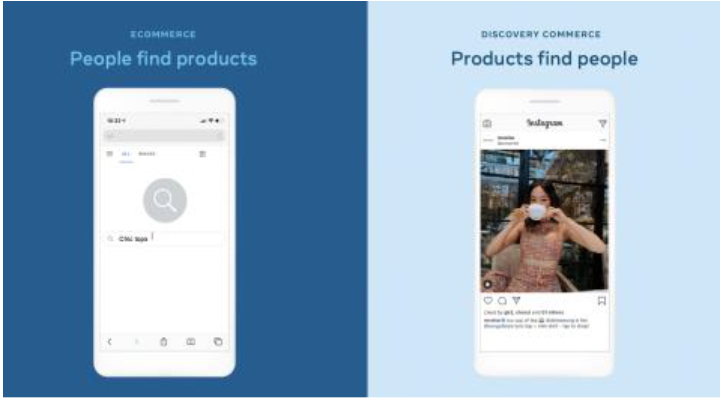
What is going to disrupt the world of commerce
massively? Something we call Discovery Commerce.
When you hear Discovery Commerce, it means you're
buying on a social network. The very important
consequence of moving to Discovery Commerce is
that intent capture is disappearing. Let me explain
what I'm talking about.
Remember, when you go to a mall, you take
your car, I know that you're going to buy because
you're going there in your car. With ecommerce, you
start searching, you are sending the signal of intent, "I
am in market. I'm interested in that product, that
category." And then, "Start serving me ads/info for
brands in that category”.
But because most of us are on social sites a lot, we
send signals all the time - what we like, what our friends
like, what we're interested in. And what happens is that
the algorithm knows so many things about you that it
will start showing you products for which you have not
yet had that conversation with yourself that you need
that product. You haven't internalized the fact that you
need that product. But you have in fact, sent out many
signals that you're ready for it. You are going to
discover that product in social network environments,
and you are going to convert as you discover it.
That's called Discovery Commerce because the funnel
is completely collapsed. By the time it sends you an ad,
you make awareness, consideration, preference,
purchase in the same millisecond. You're like, "Oh, this is
a great product. That's a great offer. I'm going to buy
it." Not everyone going to do this but what I can tell you
is that with the ongoing improvements capacity of
algorithms, it will start sending you more and more
precise products.
F Yuval Harari has written that the big platforms
may know things about ourselves that we
don't even know. Do you recognize this? I mean, you
work for a big platform. Do you say, "We sometimes
know more about people and their preferences than
they know themselves”.
L We would never go into more personal issues
but what the algorithm does is formalize things
that we probably haven't internally formalized as much.
I’ll give you a personal example-I have been seeing
these nice design boards on Instagram, every day, for
the last three days. I haven't specifically looked for
them. But I'm doing some home improvement in my
kitchen right now. I've been looking for things, looking
at design examples.
So, I have formally expressed an interest in the field. But
the algorithm is actually very good. This morning It
served me a brand with a design I really love. I don't
know this brand. It's quite expensive. I don't know if it's
worth the price. But the algorithm is getting very
precise.
F But that's good news for brands versus what
you just described in current ecommerce for
the Amazons and Alibaba’s of this world.
L Indeed. I like to call Discovery Commerce the
revenge of the marketers, because discovery
and purchase happen at the same time. The
underlying theme of sales and marketing alignment in
Discovery commerce is huge. Basically, you need to
think about your marketing as being shoppable. Your
assets need to be shoppable. You optimize for
shoppability of your assets. But you still need to provide
your brand message, your preference message, and
your purchase message in the same moment.
The format will change, there will be variations around
the format, and things like that. But marketers have a
unique chance to create brand value and create
transactions at the same time. It's a revolution.
CONVERSATIONAL COMMERCE
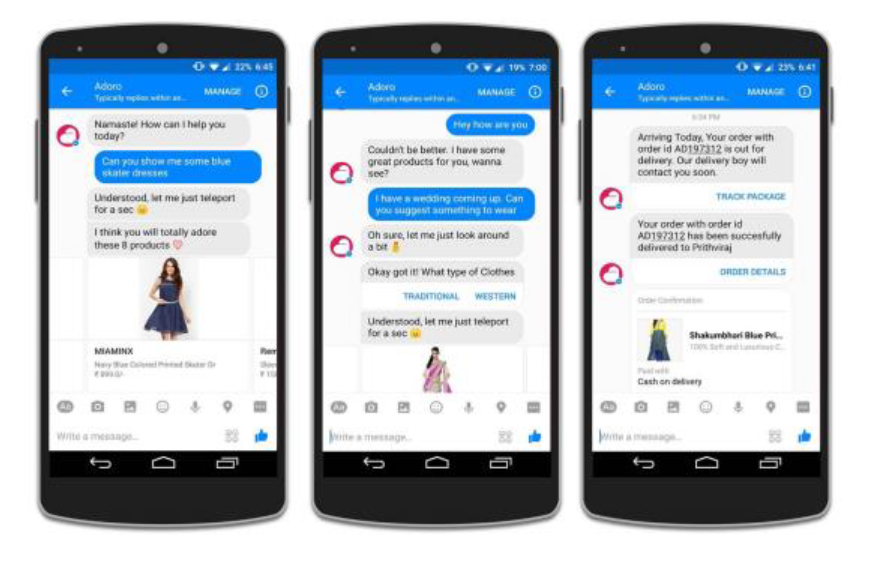
F Some people talk about Conversational
Commerce?
A You've probably heard about a bunch of
movements that have been done on the
WhatsApp or Messenger side of things lately. It's been in
the news. We spend time on social networks, including
messaging apps. A lot of people are saying that it's the
best way to interact with them. That's the one they're
most comfortable with. And it's the way they would like
to engage with brands.
You need to work on the experience. Again, it will be
about, as for Discovery commerce, what is the tone of
voice? What is the relevant type of interactions? What
is the format? And more importantly, and the biggest
challenge in conversational commerce, what's the
service level? Think about TV as one to millions. I'm a
brand, I can talk to millions, tens of millions, hundreds of
millions at the same time of people, with the same
message being broadcast at the same time.
With digital, I have say 20 or 50 assets for a campaign,
and the algorithm chooses the most suitable
combination of assets depending on who it's talking to.
It’s still one to many, but more personalized.
With Conversational commerce, it’s one to one. If
somebody messages my brand, who is going to respond
on the other side? What are they going to talk about?
How consistent is my messaging going to be versus my
overall brand messaging? Am I ensuring the right
experience so that all the brand building work that has
been done across funnel doesn't get destroyed in the
interaction?
There is a lot of automation being worked out on how to
respond fast to customer, make sure you can feed your
catalog in there, your pricing, relate to others of your
online and offline properties. It's being worked on right
now as we speak.
F One of the participants asks - Why do the
algorithms so often still get it wrong? What's
happening there? Consumers don't understand.
L There are many things behind that
phenomenon. But let me just talk about two.
Number one. We as marketers and salespeople always try
to do horizontal integration. We try to get data from all
the customer touch points we have - Google, Facebook,
TV, display networks, in store etc. And then have a single
view of the customer. And we have that single view of the
customer, so we can see where they've been touched,
with what. We know when they ‘ve made a transaction,
and we can stop stimulating them.
Unfortunately, all of that is not available to the vertical
platform. When you optimize for Google, and you feed
Google, and you sell in store, you're not telling Google
that you sold in store. This will create inefficiencies,
because there are siloes out here and we don't openly
share customer data with everyone all the time. And
that’s a good thing from a customer data privacy point of
view.
The drawback is the quality of the targeting and
personalization is not optimal. And some other channels
will keep on serving ads for somebody that is thought by
the algorithm to be in market but isn't. Because the key
information that that person has made a purchase hasn't
reached the algorithm.
DATA SHARING TO IMPROVE CUSTOMER EXPERIENCES
F I just read about an example in China, where
Burberry is working with Tencent. They are
sharing data. As a customer of Burberry, you can
schedule a visit to the store and based on the data and
the preferences Tencent have, there will be a range of
clothes waiting for you to try. What do you see? What's
the big thing happening there? Is that where things are
going in the short-term? Is that where people should
invest?
L Huge topic. Short answer - No.
Why - because there's a whole mega trend
around data signals and privacy. To protect privacy, we
have to increasingly let people choose what data they
want to share. There are increasingly more silos in the
data, that is going to prevent or at least slow down this
type of initiative.
You can do it in China. I'm not an expert on data privacy
laws in China and maybe it is OK there but outside of
China it's very complicated. So, I wouldn't jump on this
right now.
F But aren't people happy to sacrifice their data
and privacy for convenience. Isn't that the
trade off?
L You and I, yes, and probably most of the
people on the call. But we know that we are
not the general population. We're under 1%. We all live in
a bubble. Right now, it doesn't sound like it's the
preference of the general population.
We are out to find out in the coming months and years.
We know the cookie is going away. We know that a
number of things in the industry around opt-in and optout are changing third party cookie data in a way that
means it will actually vanish over time. There will be other
ways to share your data. We don't have the answer. But
to answer your initial question, whether brands should
invest in this right here, right now, I think you should
probably wait to see where this settles to make sure the
investments you're making are worth your while.
AR and VR
F Let’s move onto AR and VR or as the experts
called it XR. What's to come?
L Let me talk about the end state. The end state
is that there's a race of technologies to
replace the smartphone
If you want to talk about XR, the underlying theme
appeairng is that we are going from a main computing
interface- the mobile phone, to a main computing
interface- an augmented reality pair of glasses. We
have some smart people working with us, who are
telling me it's happening. We don't know when exactly,
but it is happening. There are still problems to be solved
but they're working on it really, really hard.
Once you've integrated this, what does it mean? And
stepping back, not just for advertising or marketing, it
changes the way humans and computers interface.
You used to interface through a phone. Now, with
augmented reality, you are immersed into the
experiences. I'll illustrate this with an example. News.
Not ads, but news.
You want to see the summary of last night's football
game? Well, you might see here, and Lionel Messi
might be next to you. Sitting next to you, kicking that
free kick, and scoring that goal. And you feel like you're
in that Barcelona Stadium on the pitch with him. And
that's how you live this. The emotional engagement you
have with that news is 10 times, 100 times, the one you
had when you were watching it on your phone.
Another example. There are floods in Bangladesh. You
are in Bangladesh with the people suffering, your level
of empathy and emotional implication is incredibly
higher than anything you've experienced previously. So
that's going to change the way we interact with
information.
What does it mean for brands? It means transparency.
Going from being told things, to living these things for
real, or in an augmented way, where they immerse you
into some kind of reality of what they are, is incredibly
emotionally engaging. Brands will have to tell
emotional stories and will have to be transparent.
If you sell Fair Trade coffee, customers might expect
you, in the future, to have live webcams that let
customers go and see your people actually working on
this. The brand and my glasses are taking me to
somewhere in Peru, and I can see that people in the
coffee plantation are treated really well, that health
and safety is respected. So, I trust you. You have to be
that transparent. So that's what XR and AR, augmented
commerce will change for us.
At the same time, AI can now show us people who
don't actually exist and yet we can't differentiate them
from people that do exist. That's the opposite of
transparency.
L There is a huge ethical mission that comes
with these technologies. That will drive social
acceptability of the technology. If people don't trust
that the tech is transparent, they will not accept the
technology.
One of the big things AI companies are working on is
social acceptability. How do you know the glasses that
somebody you meet is wearing are not normal? When
I'm looking at you, I can see your resume, I can see all
of your Facebook posts. How do I make sure you are
comfortable that we're in a balanced human
connection here that I don't know so many more things
about you than you do? How do we signal this? What
are the standards of safety? All these things, are they
right? There are a lot of things on the way to make this
safe and socially acceptable. And I know that people
in Facebook are working on this as a primary mission.
F What is your take on these two incredible
forces, technological advancement, and on
the other hand, governments and institutions or maybe
corporates self-regulating, putting the brake on things
because it's just not ethical?
L We have to learn to live with more advanced
technology and we have to make sure that
technology remains here to serve the people. And
that's something that regulators have a huge role to
play in and that's who I will look to. Self-regulation is
possible and good intentions are great, but I think
everyone would welcome clearer regulations.
Now, what needs to change practically in the business,
organize. Sales and marketing are colliding. Sales,
marketing and ecommerce.
There are a lot of companies out there where the sales
team, the marketing team and the ecommerce team
are different teams. They all have different
technologies, they are different agencies, different KPIs
etc. These silos can’t continue to exist.
Number two, the one thing you can do very practically,
very fast is optimize for platforms. Remember vertical
integration versus horizontal? I would encourage
everyone to go vertical right now. Feed the
ecommerce platform, the digital platform, the social
platforms with all the assets, product information,
pricing data they need to represent you in the most
advanced manner. Give them lots of pictures, lots of
product descriptions, lots of brand messaging, real time
pricing, real time availability.
HUMANIZING TECH IN ECOMMERCE
F Let's say Facebook is a company that is
dominated by tech people. What do you do
to ensure that what they do, and their work is human
centric, and is humanizing the growth of the company,
but also of the of their clients?
L This is not an official Facebook statement, it's a
statement from me. I'm not the right person to
talk about Facebook policy. But for me, In Facebook,
it's really easy, because Facebook is truly a purposedriven company. And the purpose of Facebook is
helping people get together and empower them to
build communities. And everyone at Facebook, when
you come in, you're being told this is the mission,
everything you will do here will be optimized for serving
that mission all the time.
F And that helps them to put the consumer or
the user front and center when they do the
work, is what you're saying?
L Yes, exactly. There's an obsession for our
mission, our responsibility.




 Download PDF
  Read online