F Today I’m honored to have with me Javier
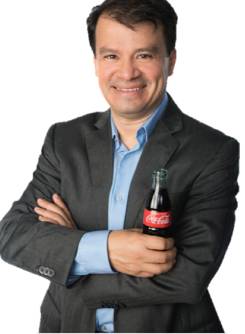
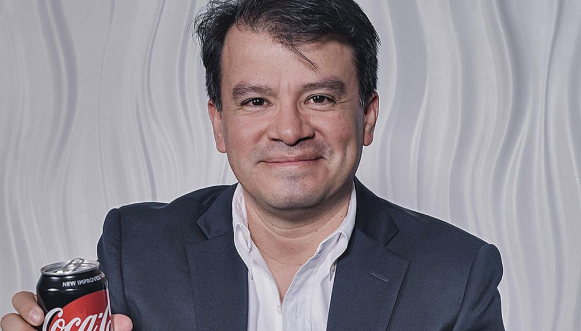
Meza, the Chief Marketing Officer for the
Coca-Cola Company’s portfolio of sparkling brands.
Javier, I wanted to start with a simple brand question:
What does Coca-Cola really stand for? What do you
want people to think when they think about CocaCola?
J I believe that Coca-Cola is one of the simpler
brands to explain, but before going there, it’s
important to note that there is the Coca-Cola
company, and then there is the Coca-Cola brand.
They are linked, but not exactly the same, especially
since our vision for the Coca-Cola company is to
expand the portfolio and into more categories. CocaCola is still our most important brand, but we have over
400 other brands across various categories. And that’s
because the overall purpose of the company is to
refresh the world and make a difference.
Let me move onto the brand. The brand is very simple.
We believe in what we call the “ladder-up.” This means
that there’s a product benefit, an emotional benefit
and a role we want the brand to play in the world and
society.
The product benefit is very simple. It is the authentic
cola taste. We are the paradigm for taste, and
especially for cola taste. Refreshment is another
product benefit. Refreshment comes from the
carbonation and the taste that is refreshing in your
mouth, and the energy kick you get when you drink a
Coke. We also have the product benefit of caffeine.
This combination of caffeine, refreshment, and the
taste gives you a kick. And that kick puts you in a better
mood.
The emotional benefit is a mood enhancer. Coca-Cola
is a simple moment that puts you in a better mood. And
we believe that when people are in a better mood,
they are more open to be authentic, to connect to
each other, and to remain positive. So at the end of
the day, the brand is: taste, refreshment, energy kick, a
mood enhancer, authenticity, inclusiveness, and
positivity.
F That’s quite a lot of words for a brand. I’ll
challenge you to boil it down to three words.
J Optimism, upliftment and taste.
Corporate Social Responsibility and Brand Purpose
F Great. Some way or another, we end up with
people being confused between CSR and a
brand’s purpose. Let me ask you, how do you see the
two, and how do you explain the difference? Or are
they the same thing to you?
J Let me park the brand aside for a
second, I’ll come back to that. Let’s start
with the company.
I really like the framework from the United Nations
with the 17 Sustainable Development Goals. When
you look at sustainability in that context, it is
economic, social, and environmental. Sustainability
encompasses all three of these areas.
In our case, for the company, the purpose
articulates that . Our purpose says we want to have
loved brands, sustainably produced, for a better
shared future for all stakeholders. We do differentiate
between the social and environmental, but just for
organizing. Within the sustainability agenda we have
some pillars. For example, sugar reduction is one of
them. The second is water neutrality and helping
with water problems. Also packaging waste and our
carbon footprint.
On shared value, of course there are pillars
regarding our own employees, working rights,
empowering communities, and empowering women
in social justice. All these areas are highly relevant
these days. So, all these areas would be the
purpose of the company. The brand has its own
purpose that is connected to the purpose of the
company, but it’s truer to the brand experience that
I explained earlier.
So, the purpose of the Coca-Cola brand is about
lifting the human spirit towards authenticity,
inclusiveness, and positivity. Returning to the
explanation that I shared about the brand. They are
connected, but it’s not exactly the same.
F Okay. And then you also have, for example,
Fanta in the portfolio. I guess the Fanta
purpose is then a different one, right?
J That’s correct. Each one of our core brands
has a purpose that is related to the product
experience. Let me explain Fanta. The way we want to
build Fanta over time is as playful, fun, and indulgent.
From the shape of the bottle, from the colors of the
liquid, from the aromas and taste. So, when you drink a
Fanta and you drink a Coke, the product experience is
different. For Fanta it’s more colorful and more flavors,
Coca-Cola is just one color, one flavor.
We believe that Fanta triggers a more playful, creative
attitude in people. When you’re drinking a Fanta, you
are more open to be creative and spontaneous. And
we believe that creativity and spontaneity have a role
to play in people’s lives. And we know that in the
current crisis, all of us are already looking for ways of
keeping motivated, because it’s very stressful to keep
going these days. So, the purpose of Fanta is this idea
of infusing creativity and spontaneity in everyday life.
That’s it.
Bringing a Brand to Life
F Infusing creativity and spontaneity in everyday
life. I’m going to ask my wife, who I just saw
struggling with six, two-liter bottles of Fanta, if she thinks
drinking a Fanta makes her creative and spontaneous.
J That’s a good point. The challenge that we
have as marketing people is not to just design
brands. You need to take that brand design, and make
it come to life in the marketplace and in actual
experiences for people. Let me give you an example,
something that I really think walks the talk when it
comes to this idea of Fanta being a creative and
playful brand. In Asia, we have a program that we’ve
repeated now for two years. It’s called WTF, and it’s not
what you’re thinking. It stands for “What the Fruit?” and
it’s been very successful.
What we do is offer for a limited time three or four new
Fanta flavors without describing the flavor to
consumers. For example, we might launch an Orange
Fanta that is blue. People will buy a blue drink and say,
“Well, this is orange.” So, we play with this idea that you
go and try and discover by yourself what the Fanta
flavor really is. It’s a way of giving this playful
experience to people.
F I have some questions from our viewers. One
asks: “Fanta, Sprite, Coke…do they have
different target audiences, or is your school of thinking
more like: ‘Let’s go for mass reach, since we don’t have
loyal consumers anyway.’ Or do you think that your
loyal consumers are responsible for just a very small part
of consumption?” Javier, how do you look at your
audience?
J Fanta, Sprite and Coke all have different
targets for communication, positioning and
purpose. The reality is the user base is really
widespread. In the case of Coca-Cola, we target for
universal appeal. And that’s challenging because, if
you want to be relevant to the new generations, and
have a brand that appeals to both teens and parents,
that’s not easy to create. It requires a lot of wellarticulated thinking, not only in the way we
communicate, but also the way we activate the brand
in the marketplace.
In the case of the Sprite, we target teenagers. It’s more
of a brand that plays with values of self-confidence,
authenticity and honesty, and that’s something
relevant for teenagers as they are going through that
process of becoming adults and defining their identity.
So, self-confidence is the key value for Sprite.
For Fanta the target is teens and young adults. But in
reality, Fanta is for the playful at heart. This notion that if
you remain playful, you don’t age – that’s something
we want to communicate with Fanta.
How Brands Can Respond to the Time
F So, let’s just look at what’s happened this past
year. We have all obviously been deeply
touched by the stands against racism and the calls for
more diversity. With a brand like Fanta, how do you
respond to what’s happening around us – without
doing the obligatory thoughts and prayers on social
media for a couple of days, and then being mostly
quiet?
J During the recent social justice crisis, and also
during the COVID crisis, the most important
question I’ve been asking myself is how can we truly
help people, their community and society? And I
believe that, in response to your question, when trying
to speak about social justice, Fanta is not going to
help. It’s not authentic. It’s not what Fanta stands for.
There’s nothing for Fanta to say about this crisis.
The Coca-Cola brand and the Coca-Cola company is
a different story, because, as I said before, we want to
make a difference and refresh the world.
And we say that the key values of the brand and
company are inclusiveness, equality, and optimism. So
yes, there’s a role for Coca-Cola to play but we didn’t
try to go fast and speak immediately. In fact, we
didn’t speak for a couple of days. And even internally
there was a good debate asking, “Hey, why are we
not speaking?” And the answer was, “Because we are
thinking.” We were thinking about ‘what to do’ before
‘what to say.’ What we did is listen to internal people
and talk to experts outside the organization, so they
could help guide our actions.
We decided to supply resources to support
organizations that are fighting social injustice. And
then, once we had decided what to say, we also put
out some communication from the Coca-Cola brand.
Again, Fanta had nothing to do with this. What I’m
trying to say is just speaking doesn’t help. You need to
act. You need to think how to help and make sure
you do that before saying anything.
Building Brands Across the Globe
F I want to shift the conversation to how you
manage brands across the globe with such
complex portfolios, and in your case over 200
countries. What’s your approach to building, creating,
and nurturing interdependencies?
J For me, the critical piece is how you create
interdependencies. How do you make it
happen? It has to be a thoughtful process. I have this
belief that you cannot create interdependencies or
collaboration by goodwill alone; you need to have
interdependencies by design. You need to design the
organization for collaboration to happen.
Here’s a couple of ideas… The first one is you need to
be very thoughtful in how you allocate resources,
people and money. As you know, scarcity drives
creativity. That’s a fact. I also know that scarcity drives
collaboration. So, the moment you remove resources,
you encourage people to collaborate. The second
one, I would say, when managing global brands, is to
remember that processes matter. Because being
super agile, but not coordinated can be very risky for
a brand like Coke.
I can give you one example that happened to me
three weeks ago. As you can imagine, I woke up in
the morning and I already had emails from Asia,
Japan, China, all with their latest ideas. One very
good proposition from Japan said: “Hey, we would
like to explore making our brands label-less. What
about removing all the labels from the brands? It’s not
really a big change in the amount of waste, but this is
a good symbolic act, right? We will reduce waste.
I said, "Yeah, that’s a good idea, but please don’t do it
on your own next month. Let’s talk about it because, of
course, it has to be coordinated. Coke-Cola is, after all,
a global brand."
On the other hand, being coordinated, but taking
three years to coordinate simply doesn’t work.
Obviously, you lose in the marketplace. So, my new
mantra is ‘coordinated agility.’ You need to be able to
drive coordinated agility. And in my perspective, you
achieve that when you connect the network, while at
the same time you keep clear decision rights. The
problem with networks is when the decision rights are
not clear making it take forever to align a point of view.
The last point is, of course, culture and trust. And you
need to reward the right behaviors. And by reward, I
mean with money, and promotions, by rewarding
people publicly who are working in interdependency,
not independency.
Aligning around Vision & Strategy
F So, when you think about these points that
you just made, and you think about aligning
and inspiring people from more than 190 countries
behind one vision, how do you make that work? How
do you deal with these convictions that things are
different in different places? They simply are. And at
the same time, they’re not.
J That’s an interesting challenge. Let me split it
into 1) vision and 2) strategy, because they
are naturally related, but not exactly the same. And
here’s what I think – marketing people, and especially
marketing people in a global role, live in the future. My
job is to think three … even five years ahead, and ask
myself: How I do want to see the brands then? If you’re
the CEO of the company, you’d ask: How do I want to
see the company? If you’re the president of a country,
then the question is: How do I see the country five years
from now?
So as a global marketing person, I live into the future.
And my job is to try to paint that future to the
organization. To paint this idea of the future with
‘imagine if.’ And if the quality of the thinking is good,
it’s not that difficult to engage people behind the
vision. The discussion is always how to bridge the
present and the future — that’s the strategy piece. The
quality of the vision is going to impact the quality of the
inspiration.
I also think it’s important for us to understand what it
means to do end-to-end brand management,
because sometimes I think we over-simplify the notion
of brand management. If you ask me, “Javier, who
manages the Coca-Cola brand in the Coca-Cola
company?” I would say, “Okay, let’s open up brand
management into its different connecting parts.”
Because if I see brand managers as only doing brand
design activities, which are understanding consumer
insights, deep human values, doing the positioning,
and the brand architecture, that’s just one part of the
job.
Then you have brand development activities, which
includes creating platforms, creating an innovation
pipeline, designing communication, and designing
promotions. Then you have the brand activation in the
marketplace, which entails deciding on what
channels, what price, and what promotional activities.
Brand design, brand development, and brand
activation – you really need to map all three activities
to two things: the best people and clear decision
rights . First, make sure that you put the best people to
tackle each piece of work. And the best people
could be in different part of the world, so use your
networks. When we need to think about brand
positioning, we don’t do that with the four or five
people sitting in Atlanta. We reach to people in the
field and involve them. Then you have networks, but
with clear decision rights. I’ve seen that problems most
often occur when you don’t have the best people, or
because the decision rights are not clear.
Alignment as Ongoing Multilevel Exercise
F Quite a few people on the call have
questions about the same topic, and that
topic is sugar. I want to link it to focus, to creating an
aligned set of priorities and actions leading to those
priorities. I know you’re doing quite a lot to fight
obesity and too much sugar intake. But in some
countries, maybe in Mexico or other countries, sugar
intake is really problematic. And I can see why local
brand managers might have different perspectives
than the people in Atlanta about pushing zero-sugar
products. So, how do you deal with that? How do you
align, and how do you respect in that sense the
differences in the market? Especially around an
important topic, like sugar, which is critical to the
future of Coca-Cola. How you deal with that?
J Alignment is a never-ending exercise. Don’t
think, “Oh yeah. We’ll meet in January, align
the rest of the year, and then meet again in the
summer and celebrate.” It doesn’t happen like that.
Alignment and calibration are a constant exercise.
That’s the first thing.
The second thing is when you need to align, you need
be thoughtful of the different levels of alignment. To
your point about sugar, the decision of reducing the
sugar footprint is something that has to be aligned as a
belief loud and clear. Until you have that aligned belief
you cannot move to the next stage which is, okay, what
actions do we implement? Because otherwise you’re
going to be discussing the belief again and again.
Make sure that you align beliefs before you align
programs. And when aligning programs, the most
important thing is to align the objective of the program
rather than the program itself. The question to ask is,
“What are we trying to achieve?” Because I see a lot of
times that we lose in the discussions about the how,
when I really want to align the what.
In the case of sugar, we want to have less calories per
liter of product we sell. And to achieve that, we have
multiple options depending on the situation of the
market. One option is to reduce the sugar in the recipe
of the product. Using Mexico as an example, we’ve
reduced 30% of the sugar of Coca-Cola classic. Now
you could ask me, “Hey, why don’t we do the same in
the UK?” In the UK, 60% of the sales of Coca-Cola are
already in zero-sugar. In Mexico, 3% of the sales are
zero-sugar. Both strategies are okay. We want to reduce
sugar in the product, and we want to promote zerosugar products more and more. And the third option is
we want to promote smaller packages. Finally, on every
package the total calories are made very visible for
consumers. So, we’ve got four pillars, but we give
markets flexibility on which ones to use depending on
their local conditions. So, aligning beliefs, aligning
objectives, and, of course, we need to align the metrics.
F I think there will always be people that say
we could do more, and others that say, “Well,
we’ve got a business to run and we’re doing quite a
bit.” Where are you? Are you in the camp that says that
you’re trying to convince your colleagues to push
harder, or are you more in the camp of, “Well, I think
we’re really proud of what we’re achieving and as long
as we’re ahead of our competitors, I’m okay”?
J Look, obesity is a real problem, and unless
we solve it, I’m not going to be okay. Can we
do more? Yes. What I believe is we need to be willing
and open to experimenting with new solutions. If you
ask me what we are doing, we are putting more
marketing dollars behind zero-sugar products. And it’s
working. The zero-sugar products in my portfolio have
been growing in the double-digits for the last three
years. Last year and the year before, more than 50% of
the growth of the brands came from zero-sugar. So,
people are moving towards zero-sugar. They are
drinking less sugar in fact.
Decision Rights and Trust
F From the questions coming up, there are is a
lot of interest in decision rights. One of the
insights I gained from studying many brands in this
space i


 Download PDF
  Read online