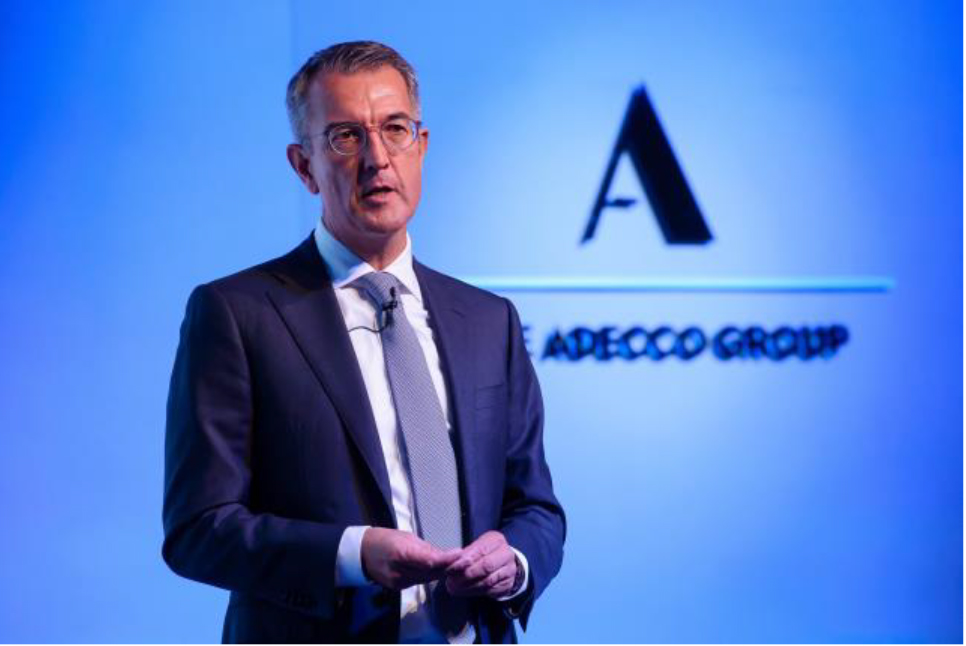
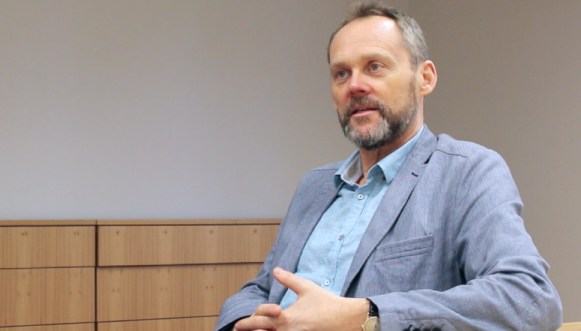
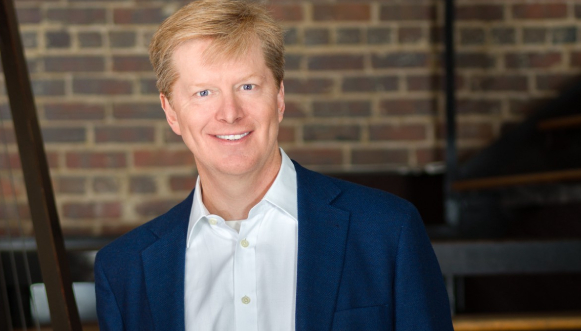
F Today I'm honored to have Hans Ploos van
Amstel, the Chief Finance Officer of the
Adecco Group, which is the world's largest temp
agency. Hans, can you tell me a little bit what's
happening at Adecco right now?
H We're going through an unprecedented
period of history. I think what is first and
foremost important for all of us is the human side. I think
we have to be here for people because what we will
be remembered for is how we manage this crisis from a
societal perspective.
For sure, we also need to manage the business
continuity. I would say to all of you, manage the crisis,
but that's not the objective. A quarter is only 1% of your
market value. It's going through the crisis with that
human touch, because people will really remember
you for how you dealt with your people during this
situation, both as a business and as an individual
leader.
“Without bringing all stakeholders along in
this society, growth won’t sustain”
F I want to talk about your CFO perspective on
the shift away from a focus on maximizing
shareholder value to what we call real growth or a
more human-centric approach to growth which is
about creating value for all your stakeholders.
That means your colleagues, your customers, the
communities that you operate in and the shareholders.
How, as a hard-nosed finance man do you look at this?
H In business we focus too much on the P&L. I
am very pleased to see - whether you go to
the World Economic Forum, whether you talk to the
investor community or even private equity - creating
value for all stakeholders is increasingly on the agenda.
I'm very happy that people are seeing the need.
They're struggling more on the how, so it's moving. I'm
very pleased with that because without bringing all
stakeholders along in this society, growth won't
continue and won't sustain.
F From a financial perspective - if the
corporation is not only about making money
for its shareholders but also about creating value for all
these stakeholders. How do you quantify that? Do you
say - first, we need to maintain these profit levels before
we can do good? What comes first and what gives
first?
H I think it's going to be the power of the end.
Milking today's business model doesn't build
the business of tomorrow because we're living in a
transformative world, both from a technology point of
view and a sustainability agenda. You need to do
both.
Three years ago, at Adecco we rewrote the contract
with our shareholders. We said, "We will perform, but we
also need to transform and innovate." First, we rewrote
the shareholder contract and said we will reinvest three
years of profit as a way of building improvements for
the future.
It was difficult at the beginning because (for the
shareholders) we were compromising short-term profit
for long-term benefits. Two and a half years later the
shareholders understand the need and are committed.
But in the beginning you have to rewrite the contract,
and this is where the business and the CFO need to
work together so that you can drive that agenda from
the viewpoint of tomorrow and the viewpoint of
continuity and sustainability.
F With the shift that you see and with the
accountability that you preach - What do you
see as a role for marketing?
H I would first say to the marketeers - there's a
few things you can do together with finance.
First, take finance away from their desks. When I started
at Procter, they took me to focus groups. Honestly in
the beginning wasn't interested in how people did their
laundry because I liked spreadsheets. I also had to sell
detergents on a Saturday in a store.
At Levi's it became automatic that I went to the store.
At Adecco I'd go to the branch. So, the first thing I
would say is bring the finance people out of their
spreadsheets and into the world, because you build a
better relationship, and you start to talk the same
language, because I think marketing people and F
finance people have quite a different language.
Importance of guidance to investors
F I have a question from one of our viewers:
“Our new fiscal year starts today. We're
spending hours and hours trying to get our forecast to
Wall Street right. How important is guidance to our
investors in these highly uncertain times?”
H For me, a budget can only be a guardrail, so
you have a measurement. It's like when you
go sailing, the wind is changing all the time, so you
have to course correct. I think in many companies the
budget process is way too rigid and gives a false sense
of security. The real benchmark should be - Are we
winning with our customers, are we winning against
competition? Now you do need a budget, but I think
an agile budget going forward is important. What we
have done with the corona crisis is only do the budget
globally, because we need to make sure we come up
to all our cash commitments, but we said to the
countries don't be too bothered about it.
Many companies still have fixed budgets. I would say -
use it as guidance - do them but don't spend too much
time on them. You need the guardrail, but it's not the
absolute guide, it cannot be.
F Along the same lines, I remember that when
Paul Polman took the reins at Unilever, he
announced that he would stop quarterly reporting. And
that cost 6% of the value of the company - billions of
dollars. He said because it's a distraction that we have
to put so much time into those quarterly reports. How
do you see it? What's your point of view? Should we all
do that? It was a brave move. He did it on his first day.
He said, "Well, then, at least they don't fire me on my
first day." But not everybody's in their first day. How do
you see that?
H You need a strategic roadmap because you
need a purpose and a vision of where you're
going and a financial framework. I think many
companies make that too complex. Every quarter I
check - are we moving forward in the right direction?
And we have three benchmarks to do that – 1. Are we
performing? 2. Did we deliver the relative growth we
needed to deliver? 3. Are we transforming, and can we
show our shareholders that we are building the
technology of tomorrow and are innovating?
My point is, it's good to have a guardrail, but don't
make it the absolute truth. That's not what it is. Here I
would work with finance, bring them into the business
so that they better understand that. In a transformative
world you have to work together, and you have to
make each other see that there might be a better and
different way. This is the relationship between finance
and marketing we need to invest in, because together
you will find a better answer. But take them to the store
as I said, build some projects together.
F You've seen quite fundamentally different
industries. Do you see that there is a
fundamentally different role for marketing and
marketing leaders in those different industries or are the
basics always the same?
H I think the role is different, in companies like
P&G it's the road to general management. In
fashion organizations the merchants have a little more
say than the marketers. But there are a lot of common
truths. I think where marketing really can help with
finance is in shaping a growth agenda that drives a
better gross margin. It’s a common thread throughout
all my businesses - How can we create more value to
get a higher gross margin? Because if that improves,
you can do a lot. I always say value over volume.
“The costs have come down and we have
seen that pricing power improved”
F In Adecco we worked together on the digital
transformation that began with defining the
customer journey. We did a lot of work in that space
and it was rigorous. You took that as the backbone for
the digital transformation.
It made me think. If a digital transformation doesn't
start with the customer journey as the backbone, it's a
missed opportunity. How do you see that, and why (as
the CFO) did you take the lead?
H I think that if you only take cost out, you will
commoditize the business and the pricing will
go. You always must work on cost and value.
I was really intrigued coming into the recruiting business
that we didn't know a lot about the experience curve
of recruiting. And you helped us by interviewing many
of the people who work for us - Why would you go to
Randstad? Why do you go to Adecco? Or even a local
player?
I was truly intrigued because in the end recruiting is
about rejection. If we see seven people in our
branches, one gets a job and the other six are pissed
off and never hear back from us. And so, when we
were building our new candidate app , we started
to measure the Net Promoter Score with candidates.
Now, a few years later. this candidate app has rolled
out across many markets. It's the number 10 app across
business, not just in our industry, and we reject less
people. You can anonymously look for a job, you don't
need to come into a branch (which is already
intimidating) and you don't have to go back home and
explain why you didn’t get the job.
Statistically 1 out of 7 people gets the job, but we're
now making it one 1 of 6. It's going to go to 1 out of 5,
which means we can place the candidates faster and
we reject less candidates. I smile as a CFO because, as
you can imagine, the costs come down and we have
seen that pricing power improved with it. It's a good
example of where you care about the candidate, the
customer is happy, you leverage technology and
experience, and your gross margin goes up.
Futureproof growth leaders
F I have another viewer question here related to
that. “Looking forward into the future, what is
your suggestion to marketing leaders about retooling
their toolbox to become true growth leaders, futureproof growth leaders? What skills would you
recommend to focus on developing and how to go
about that?"
H I have a few, but let's start with data. One, I
would call ‘demystify data’. I hired a data
science guy who reports directly into me. At the start I
didn't know what data science was versus data
analytics and felt very embarrassed. I took this guy for a
pizza every four weeks, just to educate me on what this
is all about, and he demystified it for me. He helps me
on pricing algorithms and he's training all my people to
code so that they can do it themselves.
Think through where you can leverage technology in
your function because the lines between the physical
and the technological worlds are blurring. That makes
certain businesses obsolete but also functions.
It's data, technology and then how your value chain
works. Don't just think through a marketing lens. Think
through the value creation of the business and then
how you market that.
F How do you see data privacy, GDPR and
beyond, affecting the marketing role and the
overall ability of companies to do business? What do
you see as the risks and what do you see as the
opportunities?
H For our industry that is very relevant because
you can imagine we have a lot of sensitive
data, including your payroll and personal details. You
can do a lot with the data by anonymizing it.
You need what they call good encoding so that you
can strip away what is private versus the data you can
leverage.
F I have another viewer another question - who
are CMOs that you really respected, and you
learned from? And what was their secret sauce?
“If you’re not open to learning from
everybody, you will never learn.”
H I’ll say something corny - if you are not open
to learning from everybody, then you will
never learn, I truly believe that. I didn't study very well
when I was young. And that's actually a blessing
because I probably listen more to different people.
I learned a lot from the Procter marketeers, they were
very inclusive in working with finance, they taught me a
lot and they gave me the room to do things. We would
go to customers together. I think that dialogue helped
a lot.
The other people I learned a lot from were in the
fashion industry because the emotional side of fashion
brings the marketing to a different level and dimension.
And in our business, I worked with our CMO very closely,
and he was also very keen to learn from me.
Embrace learning is my biggest thing and always work
as a team. I don't believe it's about a perfect
marketeer or perfect finance guy. I think silos are killing.
My advice to you is, invest time in building relationships
and in the learning curve because we both know when
you learn it's like going to the gym for the first time. It's
not going to happen in a week that I lose my stomach.
That takes probably a year. And the same when you
learn a new skill set. Don't give up.
F Your business model over the past years is
already more office light and virtually heavy,
reducing significant fixed costs. Post COVID this might
increase even more. How are you taking this into
account? Is this just an acceleration of something that
was going on, or are you shifting gears?
H For us that's a plus because we're still a
fragmented industry, so that will drive more
business to the larger players because technology will
make the true difference. We see that already. Our
virtual candidate tools which we have, have helped us
a lot to help key customers in the retail sector.
We see more flexibility. Retooling, reskilling, I mean we
get thousands of requests to retool, to rescale the
workforce. We train marketeers on data analytics. We
have complete programs to retool, re-skill the
workforce.

 Download PDF
  Read online